



Research Team Turning Cheese Byproducts into Bioplastics
UC Davis, Dairy Industry Working to Reduce Processing Waste, Create Green Packaging
California produces 2.4 billion pounds of cheese each year and the leftovers from making your favorite feta, gouda and cheddar could be the source of compostable biodegradable plastics like packaging, spoons and cup liners.
Researchers at the University of California, Davis, are working with the dairy industry to turn these so-called co-products or byproducts into bioplastics, and scaling up the technology could help the state meet a 2032 goal for all single-use packaging to be recyclable or compostable by 2032.
“There is a lot of potential,” Distinguished Professor Ruihong Zhang said. “It can be used for making different types of plastics.”
A green solution to waste
A pilot scale fermentation and processing technology being developed in Zhang’s lab could also help industry meet consumer expectations for biodegradable packaging and provide other revenue streams for farmers.
The California Dairy Research Foundation, California Dairy Innovation Center, Dairy Management Inc., Hilmar Cheese Company, Inc. and Leprino Foods are supporting the research, which comes at a time when consumers are demanding products that are free of fossil fuels.
Industry is also looking for ways to find more uses for byproducts, said Veronique Lagrange, executive director of the California Dairy Innovation Center and the California Milk Advisory Board.
“The industry is always looking for new ways to deliver value for that product, so the work UC Davis is doing is extremely, extremely valuable because it opens up a new market for that ingredient,” she said. “It’s really about maximizing the use of milk, the return to farmers and meeting consumer demand at the same time.”
The focus is on reducing costs and maximizing usefulness so the technology can be scaled up and used commercially. Typical plastics can cost $1 per kilogram to produce while the biodegradable plastic known as polyhydroxyyalkanoates, or PHA, which is being produced in Zhang’s lab costs about $6 per kilogram.
“Our researchers are working on reducing the production costs to have more revenues for commercialization,” said Xueyao “Kira” Zhang, a postdoctoral scholar in the Department of Biological and Agricultural Engineering. “We can solve the waste disposal issues for the cheese plants.”
Finding new high values uses

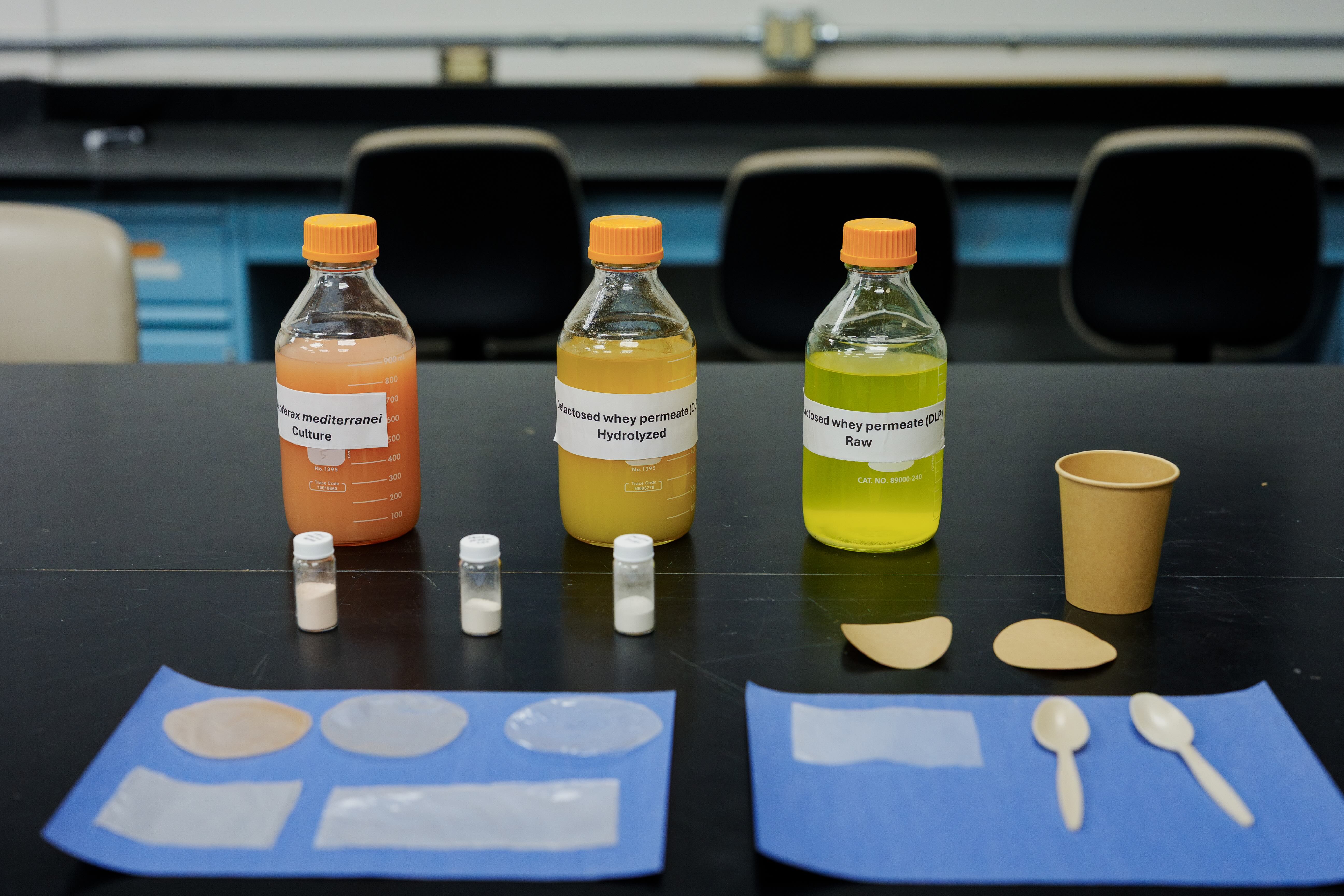
The pilot project work centers around whey permeate, which is a salinic byproduct from cheese processing. The lactose, or sugars, from the whey permeate are fermented using salt-loving microbes. Polymers are then extracted from microbes and purified, resulting in a PHA powder, which is a biodegradable plastic, Zhang said.
That PHA powder can be formed into thin films or solid items.
Although some processors recover roughly two-thirds of the lactose for use in infant formula, pharmaceutical tablets and other products, the remainder is typically sold on animal feed markets, which are lower value, said Alex Hobby, a UC Davis alum and the technical manager for water reclamation at Hilmar.
Hobby did his dissertation on bringing value to cheese byproducts through bioplastic production in Zhang’s lab. At Hilmar he acts as an informal consultant on the work.
“This collaboration is kind of expanding outside the box,” Hobby said. “What else is out there to open up new possibilities of how we can grow the dairy industry into other markets?”
The USDA’s Western Regional Research Center is collaborating on the research, offering up use of their large-scale centrifuge and other equipment for bioplastic processing.
From whey permeate to packaging
Whey permeate is a good base feedstock for the type of fermentation process used because it is high in sugar and salt content, so working with it does not require sterilization, reducing the process cost. PHA is also biodegradable in more environments than other common bioplastics.
“It can be biodegradable in almost all natural environments, like soil in the backyard and the ocean,” Xueyao Zhang said.

Media Resources
Media contacts
- Ruihong Zhang, Department of Biological and Agricultural Engineering, [email protected]
- Xueyao Zhang, Department of Biological and Agricultural Engineering, [email protected]
- Emily C. Dooley, College of Agricultural and Environmental Sciences, [email protected]