



Robert Mondavi Institute for Wine and Food Science: Leading the Way 25 Years Later
Transformative Gift Enabled Better Facilities, Science and Educational Opportunities

A quarter-century after its founding, the Robert Mondavi Institute for Wine and Food Science is a place of groundbreaking discoveries, collaborations and educational offerings attracting top-notch students, scholars and researchers.
A transformational gift of $25 million from the Robert and Margrit Mondavi family in 2001 established the RMI to study, advance and improve wine, brewing and food sciences.
The complex, which is clustered around five buildings and a vineyard, propelled the University of California, Davis, campus into a green building revolution. And it set in motion a legacy of giving that remains today.
“In the world of wine, we have the term ’terroir,’ a French word used to convey a sense of time and place,” said Ben Montpetit, chair of the Department of Viticulture and Enology. “The Robert Mondavi Institute is our version of excellent terroir. It’s the people and place coming together to do something amazing. I see the land and these buildings being the foundation of that, and that’s what Robert and Margrit Mondavi built.”

The gift brought the Departments of Viticulture and Enology and Food Science and Technology together in a space that offered hands-on experiences, fostered collaboration and a nimbleness to address emerging challenges. It also created the Robert Mondavi Institute, an educational and outreach arm that organizes events, speakers, tastings and educational opportunities. A separate $10 million gift named the Robert and Margrit Mondavi Center for the Performing Arts.
“It’s difficult to over-emphasize the magnitude of the impact of the gift,” said professor emeritus Andrew Waterhouse, the Department of Viticulture and Enology chair during RMI construction. “This facility inspired the campus to very successfully go green, increased our industry interactions and showed brewing, food and wine industries that you can make facilities that are sustainable.”
TASTE, the RMI’s annual fundraiser that showcases wine, music and art, occurs on Oct. 10 and kicks off a year of events celebrating the landmark gift.
A gift that kept giving

At the time, the donation was the largest private contribution to UC Davis.
“Education is part of our family’s passion,” said Michael Mondavi, founder and partner in Michael Mondavi Family Estate. “I know that my father, I know that Margrit, and I also believe that my mother, who passed away years before, would be very proud of what Davis has done over the last 25 years with that seed investment.”
UC Davis research that today supports natural, organic, biodynamic and integrated pest management will lead to a healthier environment, he added. “It is more exciting and I think fulfilling to the students who are learning about it,” Mondavi said. “And I think that the next 25 years will help refuel the world through proper agriculture.”
Hi-tech learning and research
The buildings that opened in 2008 featured sophisticated technology, spacious classrooms and labs representing future industry standards. The Teaching and Research Winery was the first winery globally certified as LEED platinum.
“Higher quality facilities enable higher quality science,” said Ned Spang, director of the Robert Mondavi Institute. “There’s no doubt about that.”

The new buildings and the promise they held also encouraged other donations, small and large. “That initial gift led to a cascade of follow-on gifts that have enabled us to build the world-class facilities and research program that we have today,” Spang said.
The complex today features the August A. Busch III Brewing and Food Science Laboratory, the California Processing Tomato Industry Pilot Plant, the Food Innovation Lab, Good Life Garden, J. Lohr Fermentation Hall, Jess S. Jackson Sustainable Winery Building, the Milk Processing Lab, Teaching and Research Winery, and a Sensory Building that is home to the Silverado Vineyards Sensory Theater.

“The special facilities enhance experiential learning for students and give them a world-class venue to put classroom theory into practice,” said Chris Simmons, Department of Food Science and Technology chair. “They prepare students for the equipment and operations they’ll encounter in their careers.”
In the pilot plant, students and researchers can work with many food processing operations with access to pasteurizers, choppers, evaporators, heat exchangers and other tools. A team working there now is developing alternative meats.
Responsive to industry and changing needs
“It was designed to be adaptive, with stations that allow us to rotate equipment in and out to serve whatever the educational and research program is for that time,” Simmons said. “It’s dynamic, it’s evolving, it’s really whatever it needs to be.”
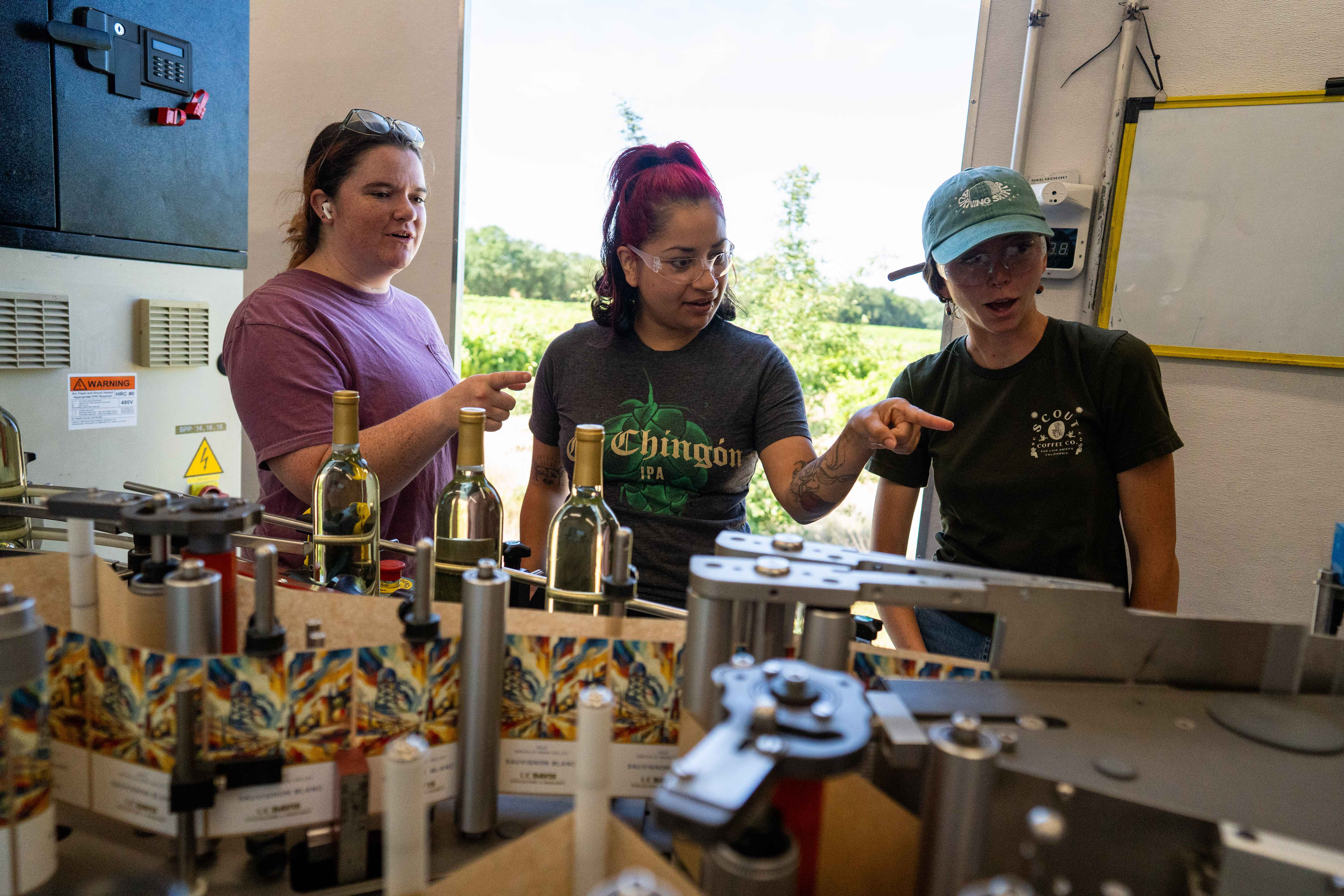
The same is true for the Department of Viticulture and Enology, where there is room for researchers to respond to industry needs – such as smoke exposure from wildfires – on a large scale. Students can also learn at a scale on par with industry standards and operations. Under the Hilgard631 label students make wine, bottle it, design the labels and sell their creations. Internships are also available.
“We’re able to get students into our winery early in their career,” Montpetit said. “By combining a foundation of rigorous science and the hands-on winery experience, we know our graduates will be that much more capable and valuable out in the world.”

Media Resources
- Ben Montpetit, Department of Viticulture and Enology, [email protected]
- Chris Simmons, Department of Food Science and Technology, [email protected]
- Edward Spang, Robert Mondavi Institute, [email protected]
- Emily C. Dooley, College of Agricultural and Environmental Sciences, [email protected]